
Ignition gives your team a powerful platform to build, host, and maintain. SimpliScada delivers serverless SCADA with hardware, cellular, upgrades, and support included.
The Short Answer
Both platforms can run a water system well. The real difference is who builds, hosts, and maintains the system after go-live.
Choose Ignition if…
- You have in-house SCADA and IT staff to run servers, networks, and upgrades
- You need deep custom applications like MES, Unified Namespace, Python scripting, or custom databases
- You've standardized on Ignition with a certified integrator
- You have strict on-premises or air-gapped requirements
- You want to own and control every layer of your system
Choose SimpliScada if…
- Your sites are spread out: wells, lift stations, boosters, and tanks
- You don't have IT staff to maintain servers, VPNs, or security patches
- You want sites deployed in days, with cellular and hardware included
- Your operators need to build screens, trends, and reports without scripting
- You want one predictable subscription instead of licenses, support plans, and infrastructure costs
See the side-by-side comparison ↓
SimpliScada vs. Ignition vs. Ignition Edge at a Glance
Ignition Edge is included because Edge devices paired with a central Ignition gateway are the closest Ignition setup to SimpliScada’s hub-at-every-site model.
| Feature | SimpliScada | Ignition | Ignition Edge |
|---|---|---|---|
| Architecture | |||
| What it is | Maintained, serverless SCADA service | Server-based platform you license and run | Lightweight Ignition for field devices |
| Who hosts it | SimpliScada | You or your integrator (server, VM, container, or your own hosting account) | A device at the site |
| Site connectivity | SimpliLink hub with private cellular included | You supply the network (radio, cellular, or fiber) | You supply the network |
| VPN required | No | Depends on design (VPN, DMZ, or MQTT) | Depends on design |
| Data in transit | Encrypted at the source, outbound-only | TLS available and recommended; coverage depends on design | Same options as Ignition |
| Building and operating | |||
| HMI building | Drag-and-drop, no scripting | Ignition Designer: drag-and-drop with optional Python scripting | Ignition Designer (Edge Panel) |
| Trends | No-code: pick signals and time range | Runtime charts operators can adjust, set up by a developer | From 35 days of local history (Edge Panel) |
| Reports | No-code, including compliance reports (turbidity, residual, flow) | Reporting Module, designed in the Designer | Not included |
| Mobile access | Native mobile apps included | Native iOS and Android app via Perspective | Up to 2 sessions (Edge Panel) |
| Scale | Scales across multiple sites on the hosted platform | Unlimited tags and clients per server license | Unlimited tags; 2 clients and 1 project per device |
| Alerts | |||
| Notifications | Phone call, SMS text, email, and push included | Email, SMS, voice, Twilio, and WhatsApp via Alarm Management Suite | One-way email; full alerts through a central gateway |
| Outside services needed | None | SMTP server, cellular modem, Twilio account, or SIP phone system | Central Ignition gateway |
| Cost | |||
| Licensing | Subscription with no annual license fees | Perpetual; $21,400 list for a basic SCADA build | Perpetual; Edge IIoT $945, Edge Panel $1,950 |
| Ongoing costs | Hardware, maintenance, IT, cellular, and support included in the subscription | Optional support at 16%, 20%, or 24% of retail per year | Optional support at 16%, 20%, or 24% of retail per year |
| Upgrades | Automatic and included | You plan and install; major versions cost 65% of retail without support | Same as Ignition |
| Server and database upkeep | None on your side | You maintain the OS, gateway, and backups | You maintain the device |
| Support | |||
| Support | Included | Optional annual plan | Optional annual plan |
Ignition and Ignition Edge details verified October 29, 2026, from Inductive Automation's published pricing and documentation. Ignition capabilities depend on the modules purchased and how the system is designed.
How SimpliScada and Ignition Architectures Differ
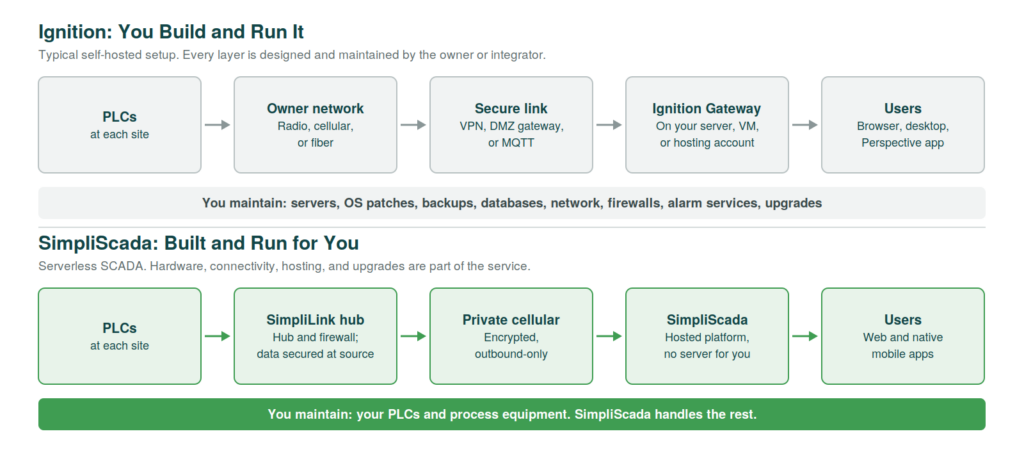
Ignition is a server-based platform. The utility or its integrator installs, secures, and maintains the server and builds the network that connects remote sites to it. SimpliScada is a serverless SCADA service. A SimpliLink hub at each site secures PLC data at the source and sends it over included private cellular to SimpliScada’s hosted platform, so the utility has no server, VPN, or database to maintain.
What is serverless SCADA? Serverless SCADA is a SCADA system in which the utility runs no servers of its own. Field devices connect directly to a hosted platform that handles data storage, HMIs, alarms, and upgrades, and operators work entirely through web and mobile apps.
Ignition: You Build and Run It
Inductive Automation licenses Ignition per server. The Ignition Gateway runs on the owner’s server, virtual machine, container, or hosting account and connects to PLCs over a network the owner supplies, such as licensed radio, cellular, or fiber. Remote access is typically secured with a VPN, a DMZ gateway, or MQTT. Inductive Automation recommends HTTPS with TLS 1.2 or higher, plus firewalls and DMZs to separate plant and business networks.
With Ignition, the owner or integrator maintains:
- Server hardware or virtual machines
- Operating system patches and gateway updates
- Backups and databases
- Network, firewall, and remote access design
- Alarm delivery services (email server, SMS modem, Twilio, or phone system)
SimpliScada: Built and Run for You
A SimpliLink hub at each site acts as both the communications hub and the firewall. It reads the PLC locally, secures the data at the source, and sends it over an encrypted, outbound-only connection on included private cellular to SimpliScada’s hosted platform. SimpliScada works with Allen-Bradley, Siemens, ABB, and most other PLCs, over protocols including DNP3, Modbus, EtherNet/IP, OPC UA, and MQTT. Operators and integrators use the same HMIs, trends, reports, and alarms through web and native mobile apps.
With SimpliScada, the owner maintains:
- The PLCs and process equipment
SimpliScada handles the hub hardware, cellular connectivity, hosting, security updates, upgrades, and support. There is no inbound port to open at the plant, no VPN for data or HMI access, and no PLC or radio network exposed for routing.
Ignition integrators can also build outbound-only field connections using Cirrus Link MQTT modules over TLS. The difference isn’t whether a secure design is possible. It’s who designs it, operates it, and keeps it secure year after year.
The bottom line
With Ignition, your team owns the infrastructure and gets full control over it. With SimpliScada, the infrastructure is part of the service, so your team's time goes to the water or wastewater system instead.
Learn more about how modern SCADA works without a server.
How Much Does Ignition Cost Compared to SimpliScada?
A basic Ignition SCADA build lists at $21,400 in software for one server, according to Inductive Automation’s published pricing as of October 29, 2026. That figure covers the software license only. The server, network, field hardware, alarm delivery services, and integration work are separate. SimpliScada is a subscription with no annual license fees that includes hardware, cellular connectivity, hosting, maintenance, upgrades, and support.
Ignition List Pricing for a Basic SCADA Build
Inductive Automation deserves credit for publishing its prices openly. Ignition is a perpetual license sold per server, with unlimited tags, clients, and designers included. A typical water or wastewater SCADA starting point includes:
- Ignition Platform: $1,200 (required)
- Application Building Suite: $13,500 (includes Perspective and Reporting)
- Industrial Historian Suite: $3,500
- Alarm Management Suite: $3,200 (includes Alarm Notification, SMS, Twilio, and Voice)
- Total software list price: $21,400 per server
Common add-ons for distributed water systems include Ignition Edge IIoT at $945 per site device, Ignition Edge Panel at $1,950 per site device, Cirrus Link MQTT Transmission at $1,550, and Cirrus Link MQTT Engine at $2,150. A redundant backup gateway requires its own license.
Ongoing Costs After the License
Ignition’s license is a one-time purchase. Ongoing costs come from support, upgrades, and everything around the software.
- Optional annual support: BasicCare at 16%, TotalCare at 20%, or PriorityCare at 24% of the software’s retail price. On a $21,400 build, that’s $3,424, $4,280, or $5,136 per year.
- Major version upgrades without support: 65% of the software’s current retail price.
- Hosting outside the plant: Inductive Automation offers Ignition Cloud Edition, billed hourly through AWS or Azure. Inductive Automation states that Cloud Edition is not a service, so users still handle configuration, backups, and upgrades.
Costs each utility prices locally include:
- Server hardware or virtual machines, plus operating system licensing
- Database licensing and administration, if used (reduced in Ignition 8.3 with the built-in Core Historian)
- Firewalls, VPN or DMZ infrastructure, and the IT time to maintain them
- Radios or cellular modems and data plans for remote sites
- Alarm delivery services such as an email server, SMS modem, Twilio account, or phone system
- Integrator hours to design, build, upgrade, and troubleshoot the system
What the SimpliScada Subscription Includes
SimpliScada bundles the infrastructure into one subscription:
- SimpliLink hub hardware at each site
- Private cellular connectivity
- Hosting, with no server or database on your side
- Automatic upgrades
- Maintenance, IT, and support
- Phone call, SMS text, email, and push notifications
For a full breakdown of what SCADA costs for small systems, see How Much Does a SCADA System Cost? and our SCADA cost FAQs for small water systems.
How Do Building and Day-to-Day Operation Compare?
Both platforms give operators screens, trends, reports, and alarms. Ignition builds them in a developer tool with deep customization options. SimpliScada builds them in drag-and-drop tools with no scripting, and includes alert delivery.
HMI Screens and Trends
Ignition: Screens are built in the Ignition Designer using drag-and-drop components and tag bindings, with Python scripting available for advanced behavior. Perspective screens run in any browser and in a native iOS and Android app. Ignition’s Power Chart lets operators add pens and change time ranges at runtime, once a developer places the chart and enables tag history.
SimpliScada: Screens and dashboards are built with a drag-and-drop HMI builder, with no scripting. Operators create trends by choosing signals and a time range, without developer setup.
What it means: Ignition gives a trained developer nearly unlimited control over screens. SimpliScada lets operators and integrators build and change screens themselves, without scripting skills.
Reports and Compliance
Ignition: Reporting requires the Reporting Module, which is included in the Application Building Suite. Reports are designed in the Ignition Designer. Historian-based reports use built-in query builders, and SQL is needed for custom database sources. Utilities have used Ignition to automate state reporting; Park City, Utah, for example, saves the equivalent of one full-time employee this way, according to Inductive Automation.
SimpliScada: Reports are built without code by choosing fields, filters, and schedules. Automated regulatory compliance reporting covers readings such as turbidity, residual, and flow.
What it means: Both can automate compliance reports. With Ignition, a developer builds and maintains each report. With SimpliScada, operators set them up and adjust them directly.
Alarms and Notifications
Ignition: The Alarm Management Suite supports alarm pipelines, escalation, on-call rosters, and notifications by email, SMS, voice, Twilio, and WhatsApp. Delivery relies on services the owner supplies, such as an email server, a cellular modem with a SIM card, a Twilio account, or a SIP phone system.
SimpliScada: Real-time phone call, SMS text, email, and push notifications are included, with mobile acknowledgment. No third-party notification services are needed.
What it means: Ignition offers highly configurable alarm logic for teams that want to design it. SimpliScada delivers alerts out of the box, with nothing extra to set up or pay for.
How Do Security Responsibilities Compare?
Both platforms can be run securely. The difference is who carries the responsibility. With Ignition, Inductive Automation secures the software and the owner secures the deployment. With SimpliScada, the security of the hub, connection, and hosted platform is part of the service.
Ignition: Inductive Automation holds ISO 27001:2022, ISO 9001:2015, and ISO 14001:2015 certifications, and its development process is certified to ISA/IEC 62443-4-1. Ignition includes strong security tools, such as TLS encryption and multi-factor authentication. Configuring them and keeping them current is the owner’s job. That includes server patching, firewall and DMZ design, and remote access.
SimpliScada: The SimpliLink hub secures data at the source and sends it only over encrypted, outbound-only connections on private cellular. There is no inbound port to open at the plant, no VPN to maintain, no exposed PLC or radio network, and no customer-hosted server to patch. That reduces the number of internet-facing systems a small utility has to secure and monitor on its own.
What it means: Ignition gives you secure building blocks and full control over how they're used. SimpliScada takes most of the infrastructure security work off your team's plate.
Frequently Asked Questions
What is the difference between SimpliScada and Ignition?
Ignition is software you license and run on your own server, while SimpliScada is a serverless SCADA service with hardware, cellular connectivity, hosting, upgrades, and support included. With Ignition, your team or integrator designs the network, secures the server, and builds screens in the Ignition Designer. With SimpliScada, SimpliLink hubs connect your PLCs over private cellular, and you build screens, trends, reports, and alerts with drag-and-drop tools.
How much does Ignition SCADA cost in 2026?
A basic Ignition SCADA build lists at $21,400 in software for one server, according to Inductive Automation’s published pricing as of October 29, 2026. That includes the Ignition Platform ($1,200), Application Building Suite ($13,500), Industrial Historian Suite ($3,500), and Alarm Management Suite ($3,200). The license is perpetual. Optional annual support costs 16%, 20%, or 24% of retail. Servers, networking, field hardware, and integration are extra.
What is a good Ignition alternative for small water systems?
SimpliScada is built for small and mid-size water and wastewater systems that want full SCADA without running a server, VPN, or database. Hardware, private cellular, hosting, upgrades, and support are included in one subscription, and operators build screens and reports without scripting. Learn more about SCADA for small water systems.
Does Ignition Cloud Edition include hosting, backups, and upgrades?
No. Inductive Automation states that Ignition Cloud Edition is not a service, and users are responsible for configuration, backups, and upgrades. It runs in the customer’s own AWS or Azure account and is billed hourly through the marketplace.
When does Ignition 8.1 support end?
Active support for Ignition 8.1 ends September 16, 2027, and Limited support ends September 16, 2029, according to Inductive Automation. Ignition 8.3, released September 16, 2025, has Active support through September 16, 2030. Upgrades are included with an active support plan; without one, a major upgrade costs 65% of current retail.
Can systems integrators work with SimpliScada?
Yes. SimpliScada works with systems integrators through its Automation Partner Program. Integrators connect PLCs to SimpliLink hubs and build screens, reports, and alerts with drag-and-drop tools, with no server or VPN to design or maintain.
Related reading
- How Much Does a SCADA System Cost?
- Modern SCADA Without a Server
- SCADA for Small Water Systems
- Serverless SCADA FAQs for Water and Wastewater
- SimpliScada vs. VTScada
How we compared: Ignition and Ignition Edge pricing, features, and support dates are from Inductive Automation’s published pricing pages and documentation, verified October 29, 2026. SimpliScada details are provided by SimpliScada. Ignition, Ignition Edge, Ignition Cloud Edition, and Perspective are trademarks of Inductive Automation, LLC.